In short
- Treated pine sleepers are the cheapest retaining wall in Australia.
- Drainage behind the wall decides how long it lasts.
- Allow $250 to $450 per m² of wall face for treated pine, built and drained.
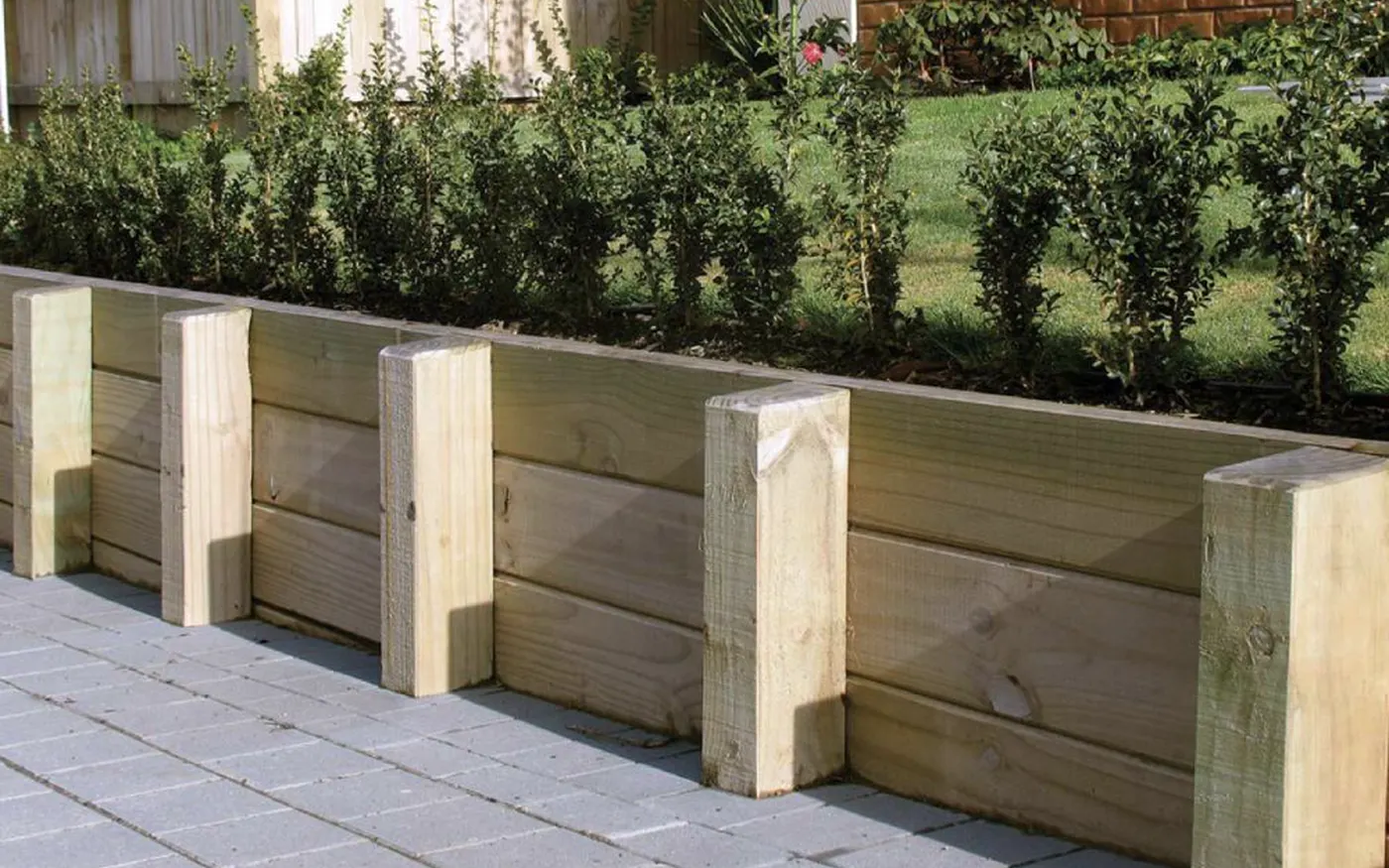
A timber retaining wall is made of horizontal sleepers held by upright posts set in concrete. It is the cheapest way to hold back a bank in Australia at $250 to $450 per square metre of wall face, and it lasts 15 to 25 years when the timber is treated correctly and water can get out from behind it.
What a wood retaining wall is made of
- Treated pine sleepers. The standard choice, usually 200 x 50 or 200 x 75 mm. Sleepers and posts in contact with the ground must be treated to H4. H3 timber is for decks and fences and will rot in a wall.
- Hardwood sleepers. Ironbark, red gum and similar species are heavier, stronger and longer lasting, at $300 to $500 per square metre built.
- Posts. Timber posts of the same treatment level, or galvanised steel H-posts with the sleepers slotted between the flanges. Steel posts cost more and remove the part of a timber wall that usually fails first.
How a timber wall is built
- Set out and dig. The line is marked and the bank is cut back to leave room for drainage behind the wall.
- Posts. Holes are bored at regular centres, commonly 1.2 metres for 2.4 metre sleepers. A common rule of thumb puts as much post in the ground as there is wall above it. Posts are stood, plumbed with a slight lean into the bank and concreted in.
- Sleepers. Fixed to the back of timber posts or dropped into steel ones, from the bottom up.
- Drainage. Pipe, gravel and fabric go in behind the wall as it rises. This step is covered below.
- Backfill and finish. Soil goes on top of the gravel, and the cut ends of any timber are sealed.
Drainage for a wood retaining wall
Most timber walls that fail are pushed over by water, not by soil. Wet soil is far heavier than dry soil, and clay holds water against the back of the wall for weeks after rain. A wall with good drainage is carrying a fraction of the load of one without.
What should be behind every timber wall:
- A slotted agricultural drain at the base of the wall, behind the bottom sleeper, laid with a fall of about 1 in 100 towards an outlet.
- Free-draining gravel, 10 to 20 mm aggregate, at least 300 mm wide from the base to within 150 to 200 mm of the top.
- Geotextile fabric between the gravel and the soil, so fine soil does not wash in and clog the stone. A sock on the pipe does the same job at the pipe.
- An outlet. The pipe has to discharge somewhere lawful: a stormwater pit, a kerb outlet or a soakage area on your own land. It must not empty onto the neighbour's property.
- Gaps between sleepers are a help, not a substitute. Water should reach the pipe before it reaches the timber.
Common mistakes are backfilling with the clay that came out of the cut, leaving the pipe with no outlet, and skipping the fabric. Each one works for a few years and then the wall starts to lean.
How high can a timber wall go?
Sleeper walls are commonly built up to about a metre without engineering in most states, and higher with an engineer's design. The approval height differs by state and is lower in New South Wales. A driveway, building, pool or steep slope above the wall counts as extra load at any height. See retaining wall regulations in Australia.
Cost
| Wall | Guide price |
|---|---|
| Treated pine sleepers | $250 to $450 per m² |
| Hardwood sleepers | $300 to $500 per m² |
| Concrete sleepers, for comparison | $400 to $700 per m² |
| Engineer's design, when needed | $1,000 to $3,000 |
Guide prices in Australian dollars including GST, per square metre of wall face, built and drained, on a site with reasonable access. A written quote after a site visit is the only firm figure.
A wall 10 metres long and 800 mm high is 8 square metres: $2,000 to $3,600 in treated pine. The retaining wall cost guide has more examples.
How long it lasts, and when to choose something else
Treated pine gives 15 to 25 years, hardwood longer. Timber is the wrong choice where the wall holds up a driveway or building, sits in permanently wet ground, is close to the house on bushfire-prone land, or would be very hard to replace later. Concrete sleepers or block cost more and last 50 years. For layout ideas, see timber retaining wall design.
When you are ready for a firm price, the retaining walls page shows the company listed for each area.
Common questions
What treatment level should retaining wall timber be?
H4 for sleepers and posts in contact with the ground. H5 is used for critical structural posts and wet sites.
Do timber retaining walls need drainage?
Yes, every one. An agricultural drain at the base, gravel backfill and filter fabric, with an outlet, are what stop the wall being pushed over.
How deep should retaining wall posts be?
A common rule of thumb is as deep as the wall is high, in concrete. Soft ground, slopes and loads above the wall need more, and an engineer sets the depth on taller walls.
How long does a treated pine retaining wall last?
About 15 to 25 years with H4 timber and working drainage. Walls built from under-treated timber or without drainage can fail in under ten.